
Animal Card Match Puzzle
What players say
Animal Card Match Puzzle works well as a low-pressure matching game. Its two moving lines create a steady observational challenge without timers or complex rules. The cute animal graphics and tap controls suit families and casual players. The main limitation is repetition: the core loop stays the same, so players seeking varied mechanics or progression may find it shallow over long sessions.
How to play
Matching Moving Lines
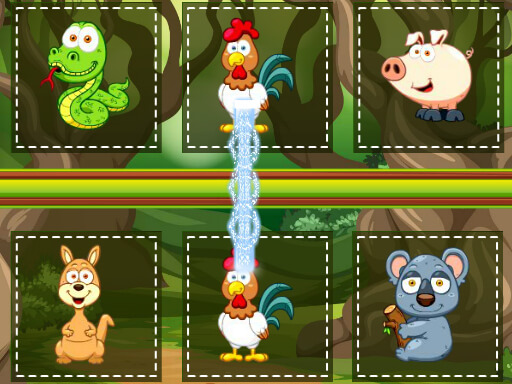
Animal Card Match Puzzle presents two horizontal rows of animal cards that scroll continuously. Your task is to watch both lines and tap a card from each row when two identical animals appear directly opposite one another. A correct tap removes both cards and adds points to your score. Because the lines never stop, timing and observation matter more than speed alone.
Simple Controls, Steady Challenge
There are no timers, lives, or complicated rules. The only action is tapping matching pairs as they align. New cards keep appearing, so the game never reaches a fixed end. This structure makes it easy to start but still tests your ability to track patterns across two moving rows. [IMG_1]
Visual Style and Audience
The game uses charming animal graphics that suit its family-friendly tone. Cute illustrations keep the screen readable while the cards move, helping you spot matches without visual clutter. The simple tap controls work for young children and adults alike, and the absence of pressure makes it a relaxed choice for short sessions. [IMG_2]
Building Accuracy Over Time
Practice improves both speed and accuracy. Watching the movement patterns of each line helps you anticipate when a matching pair will line up. Rushing often leads to mistaps, so staying calm and using short, focused sessions can sharpen your observation without fatigue. Over time, you develop a rhythm that clears pairs more efficiently.
✅ Compatibility & Testing
FAQ
Comments
Sign in to comment
You must be logged in before posting a review or rating.
No comments yet. Be the first to comment!



Editorial Notes