
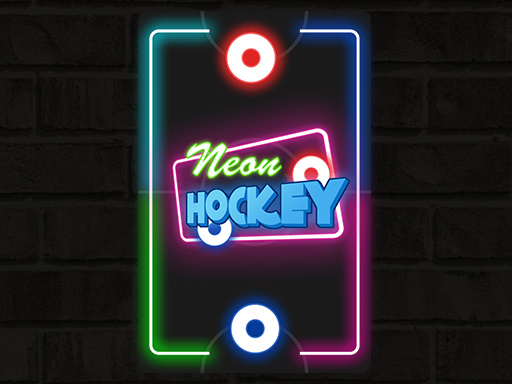
Neon Hockey Arcade Game
What players say
Neon Hockey Arcade Game keeps the table hockey formula intact while dressing it in a bright neon look. Its strengths are accessibility and pace: basic keyboard or mouse inputs, matches that last minutes, and a CPU opponent that scales to your skill. Local two-player support adds a social option. The trade-off is depth, since the rules stay deliberately simple and there is no indication of online play or extensive modes.
How to play
What Neon Hockey Arcade Game Offers
Neon Hockey Arcade Game translates the physical table hockey experience onto a screen, replacing wooden paddles and a plastic puck with glowing equivalents. The objective never changes: send the puck past your opponent's paddle while keeping it out of your own goal. A bright neon color scheme defines the look, giving the playfield a modern arcade character without obscuring the puck or paddle positions. Matches are short by design, usually lasting only a few minutes, which makes the game easy to pick up during a break or to play repeatedly in one sitting.
Controls and Match Flow
You move a paddle to intercept the puck and redirect it toward the opposite goal. Inputs are limited to basic keyboard or mouse actions, and there are no layered menus or rule screens standing between you and a match. That simplicity puts the emphasis on timing and positioning rather than on learning complex commands. Because the puck moves continuously, reading its angle early and drifting your paddle into the right lane matters more than reacting late with a fast swipe.
Solo Play and the Adaptive CPU
Single-player mode pits you against a computer opponent that adjusts its play to match your skill level. That means a newcomer is not immediately overwhelmed, while a more experienced player still faces a contest that responds to improved performance. Watching the CPU's habits, such as which side it favors or how quickly it recovers after a shot, gives you information you can use to anticipate its next move.
Local Two-Player Competition
A second mode lets two people compete on the same device using separate controls. This is local play only, so both players share one screen and one machine. Reflexes and quick communication carry more weight here than in solo mode, since a human opponent will not follow the same patterns as the CPU. The family-friendly presentation and absence of inappropriate content make it a reasonable option for mixed-age households.
Compatibility
FAQ
Comments
Sign in to comment
You must be logged in before posting a review or rating.
No comments yet. Be the first to comment!


Editorial Notes