
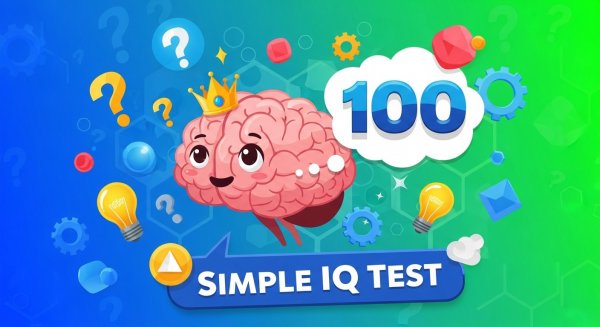
Mind Flex Puzzle Test
What players say
Mind Flex Puzzle Test works best as a brief mental warm-up rather than a long-term training tool. Its rotating question formats—patterns, memory, visual, and math—keep sessions from feeling repetitive, and the absence of a timer makes it accessible for players who dislike pressure. The minimal interface and browser-based design suit short breaks. The main limitation is that nothing carries over between sessions: no saved scores, no difficulty curve, and no progress tracking. Players who want measurable improvement may find that lack frustrating, while those seeking a casual quiz will find it fits the purpose.
How to play
Question Types That Rotate
Mind Flex Puzzle Test mixes several question formats within a single session. Pattern-recognition rounds ask you to identify what comes next in a sequence. Memory rounds show information briefly and then ask you to recall it. Visual puzzles involve spotting differences or recognizing shapes. Math questions cover basic arithmetic and logical deduction. Because the format changes from question to question, you cannot settle into one mental routine.
How a Session Unfolds
After you choose the start option, the quiz begins immediately. You answer a series of multiple-choice questions at your own pace. No timer runs in the background, so you can pause on a tricky item without penalty. Once you finish the set, the game calculates a total score from your correct answers and displays an estimated result. That result gives you a rough sense of how you performed against the challenge.
Interface and Accessibility
The layout stays minimal: large buttons, clear text, and one question visible at a time. This reduces visual clutter and keeps your attention on the current problem. The game runs in desktop and mobile browsers, accepting mouse clicks or finger taps. No account creation or personal data is required, so a session can start during a short break or a commute.
Practice and Mental Agility
The game does not track long-term progress or store historical scores. Replay value comes from trying to beat your previous result and from the shifting question types. Regular play can help you practice switching between logical, numerical, and visual thinking. Over time, you may notice faster and more accurate responses to similar problems, though the game itself does not measure that improvement.
Compatibility
FAQ
Comments
Sign in to comment
You must be logged in before posting a review or rating.
No comments yet. Be the first to comment!


Editorial Notes